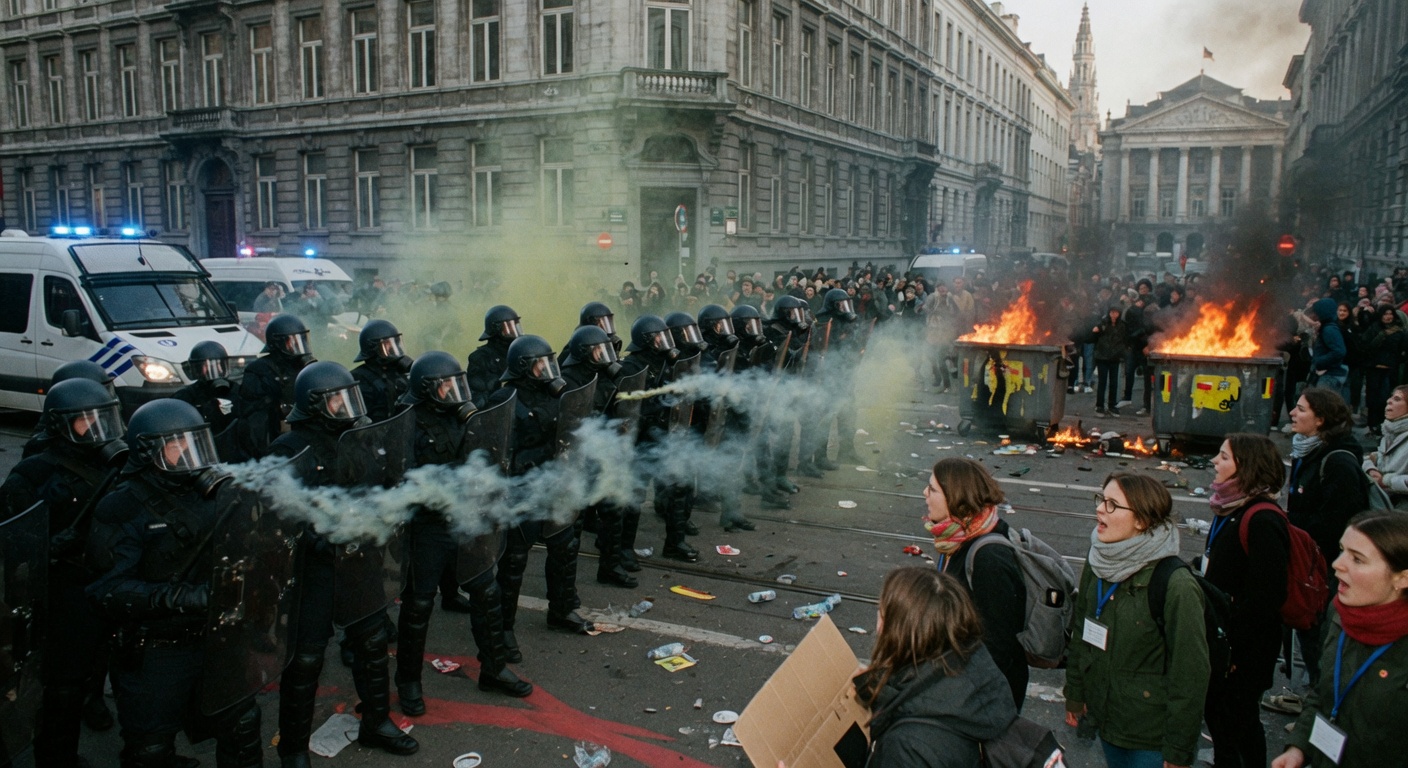
Students and teachers clashed with riot police in Brussels on Thursday, June 4, 2026, protesting proposed education reforms. More than 1,000 demonstrators gathered near Brussels Central Station to oppose “Decret Programme 2” austerity measures, including tuition fee increases. Police deployed tear gas and stun grenades to disperse crowds as clashes turned violent.
The protests target “Decret Programme 2,” a series of austerity measures introduced by the French-speaking Federation Wallonia-Brussels (FWB) to address a 1.9 billion euro budget deficit. The reforms propose increasing tuition fees, known as minerval, from 835 to 1,194 euros for approximately 58% of students.
Clashes escalated in the city center as protesters lit fires in the street and confronted security forces. Brussels police used tear gas and stun grenades to regain control of the area.
The reforms have sparked a political divide. The majority coalition, consisting of MR and Les Engagés, maintains the cuts are necessary to stabilize the budget and ensure the education system’s long-term viability. Opposition parties have denounced the government’s tactics, calling the rapid acceleration of the vote a “deni de démocratie” (denial of democracy).
Students and teachers argue the decree will lead to the “precarisation” of education, contending that tuition hikes will undermine accessibility and worsen working conditions for educators across the federation.
The protests reflect tension within the French-speaking Federation Wallonia-Brussels over the balance between fiscal discipline and social investment. As the government moves to close the 1.9 billion euro deficit, “Decret Programme 2” remains a flashpoint for those warning that austerity will permanently diminish the quality and accessibility of the region’s education system.