The European Commission has issued a formal mandate to Tirana to act without delay over the Sazan and Narta development projects. The Commission warned that the “Special Procedure” used to fast-track these investments violates the Environmental Acquis and threatens Albania’s EU accession path. This legal friction exposes the structural anomaly of the “Strategic Investor” status, which Jared Kushner’s Affinity Partners has leveraged to secure a former NATO military choke point and vast coastal wetlands. By operationalizing a “War Cabinet” of former US officials and utilizing Gulf sovereign wealth routed through Dutch shell companies, the fund has bypassed democratic oversight to capture geostrategic assets—a process linked to criminal land-title forgery and the systemic erasure of protected territories.
The Brussels Friction and the “Strategic Investor”
The tension between Tirana and Brussels is not a bureaucratic disagreement over zoning; it is a structural conflict over the rule of law. The European Commission’s formal mandate to “act without delay” regarding Sazan and Narta serves as a diagnostic marker for a systemic failure. By invoking a “Special Procedure” to fast-track these projects, the Albanian government has created a legal vacuum where the Environmental Acquis—a cornerstone of EU accession—is treated as optional.
This “Strategic Investor” status is the primary mechanism of the operation. It is an administrative bypass that allows the state to override procurement and environmental protections, transforming a sovereign regulatory framework into a concierge service for private equity. For Affinity Partners, this status is not an investment benefit but a tool of territorial capture. By securing this designation, the fund has insulated its operations from democratic oversight and judicial review, creating a legal anomaly that allows for the seizure of assets that would be untouchable under standard Albanian or European law. The result is a significant precedent: the use of EU accession aspirations as a shield to undermine the very standards that accession requires. As of mid-2026, that precedent is still being contested: SPAK has frozen approximately $195 million in accounts linked to the project, the Commission’s mandate remains unresolved, and the legal basis of the Strategic Investor designation is under active review.
The Physical Asset: Sazan’s Subterranean Value
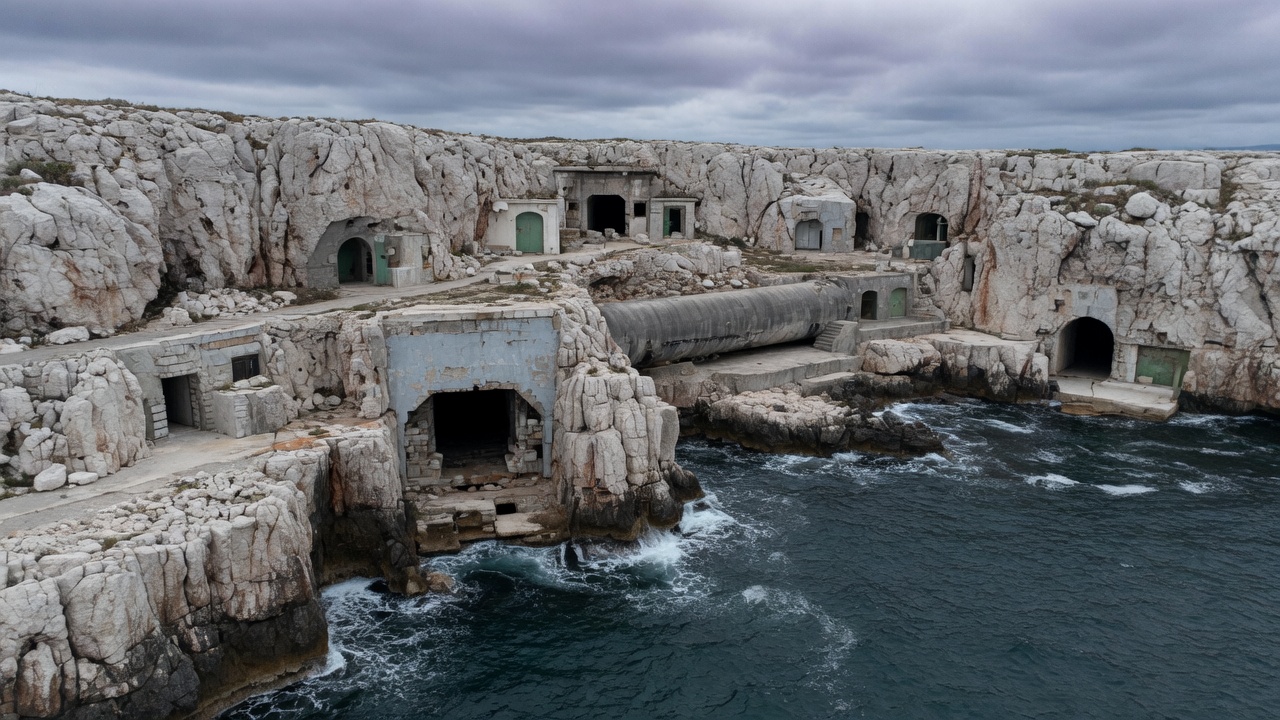
To view the Sazan project as a luxury resort is to mistake the camouflage for the objective. The true value of Sazan Island lies in its subterranean architecture and its position as a geostrategic “plug” for the Adriatic. Historically, Sazan has been the definitive choke point of the Strait of Otranto; Khrushchev noted that control of the island allowed the Soviet bloc to govern the Mediterranean from Gibraltar to the Balkans.
The island is a sprawling network of military antiquity: 3,600 bunkers and ten miles of Cold War-era tunnels carved into limestone. This infrastructure is not a liability to be cleared for tourism. It is a ready-made, hardened facility that, in a multipolar context, suggests the capacity for a private signals intelligence (SIGINT) hub or a secure command-and-control center. In the hands of a private equity firm staffed by former intelligence and defense officials, these tunnels could represent a strategic asset that bypasses the need for state-level diplomatic treaties.
By wrapping this military infrastructure in high-end hospitality branding, Affinity Partners achieves two objectives. First, it provides a plausible cover for the presence of specialized personnel and sensitive equipment. Second, it transforms a high-risk military occupation into a “development project,” shifting the discourse from national security to economic growth. The resort is the interface; the tunnels are the operational core. The evidence suggests Sazan is being positioned as a private foothold at one of Europe’s most critical maritime corridors—one that no tourist infrastructure alone would justify.
The “War Cabinet” and the Shadow Diplomatic Corps
The operationalization of the Sazan project is not the work of real estate developers, but of a specialized “War Cabinet”—a thirteen-person team of former high-ranking US government officials who have replaced traditional diplomacy with a transactional private equity model. This is a shadow diplomatic corps where professional roles are mapped not to state functions, but to the needs of a private fund.
The architecture of this team is diagnostic of privatized statecraft. At the center is “The Broker,” exemplified by Richard Grenell. The Broker operates in the grey zone between sovereign political power and private capital, leveraging personal relationships with heads of state to secure “Strategic Investor” status before official channels can register an objection. This ensures the project is viewed as a political favor rather than a regulatory process.
Supporting this is “The Geostrategist,” such as Maj. Gen. Correa, who provides the structural analysis required to identify assets like Sazan—not for market value, but for strategic utility. The Geostrategist identifies the “plug” (Sazan) and the “buffer” (Narta) and maps them onto the fund’s global portfolio.
Complementing these are “The Erasers,” specialists like John Rader, whose expertise lies in the administrative and legal scrubbing of operations. The Eraser ensures that the “Strategic Investor” bypass remains unchallenged by creating a layer of procedural complexity that exhausts local regulators. By the time a local court or an EU auditor identifies a violation, the Eraser has already shifted the legal entity or amended the project’s scope. The operation stays one step ahead of the law.
By embedding these roles within Affinity Partners, the fund has operationalized a government-in-exile. They do not negotiate treaties; they negotiate deals. They do not seek diplomatic alignment; they seek territorial access. This shift is critical: when statecraft is privatized, the objective is no longer the national interest of the US or the sovereignty of Albania, but the proprietary advantage of the fund and its backers. The “War Cabinet” does not represent the US government; it represents a private entity utilizing the prestige and networks of the US government to execute a capture strategy. The tools of empire are leased to a private equity firm, allowing it to conduct geopolitical maneuvers with the agility of a corporation and the operational opacity of a private entity.
The Sovereign Loop: From Gulf Capital to Territorial Capture
The financial engine driving this operation is the “Sovereign Loop,” a three-stage pipeline designed to decouple the source of capital from the physical seizure of land. The loop begins with the deployment of Gulf sovereign wealth, routed through opaque layers to mask beneficial owners and avoid the diplomatic friction that accompanies direct state-led land grabs in Europe.
The primary mechanism of this opacity is the “Zuidas Proxy Architecture” in Amsterdam. The use of Dutch Trust Management B.V. and “Ghost Directors” like Nikita Vinogradov creates a legal firewall between Gulf SWFs and the Albanian projects. This Dutch shell structure allows capital to enter the system as “private investment,” stripped of its sovereign identity, before it is channeled into a Delaware-based Special Purpose Vehicle (SPV), such as Atlantic Incubation Partners.
Once the capital is absorbed into a private corporate form, it is deployed into Albania under “Strategic Investor” status. This is the final turn of the loop: the transformation of anonymous Gulf wealth into a legal mandate for territorial capture. By the time the land is secured, the connection to the sovereign wealth fund is buried under layers of Dutch and American corporate law.
This architecture achieves a precise objective: it allows Gulf states to acquire geostrategic footholds in the Mediterranean without the political cost of formal colonialism or the transparency of bilateral treaties. The “Sovereign Loop” privatizes territorial expansion. It transforms a state-level ambition into a private equity transaction, ensuring that the physical capture of Sazan and Narta is seen as a commercial development rather than a geopolitical shift. The map is redrawn not by diplomats, but by trust managers and shell company directors.
The Criminal Root: Forgery and Mafia Links
The “Strategic Investor” status provides administrative cover, but the actual seizure of land is built on criminal forgery and judicial capture. The legal titles presented to the Albanian state are not the result of legitimate transactions, but the product of a systemic network of fraud designed to erase the rights of original landowners.
The operational core of this land-theft engine is exemplified by Pellumb Petritaj. Petritaj was convicted for the forgery of land titles, specifically utilizing falsified Ottoman-era documents to create a veneer of historical legitimacy for claims with no basis in law. This process involves “mining” archives for obscure historical references and fabricating deeds that “prove” ancestral ownership of vast coastal tracts. Once these forged titles enter the registry, they are used to displace current owners through rapid-fire sales to the fund’s vehicles.
This is not opportunistic fraud, but a coordinated effort to “cleanse” titles before they are handed over to the fund. The scale of this operation is reflected in the actions of the Special Anti-Corruption Prosecutor’s Office (SPAK), which froze approximately $195 million in accounts linked to Albania Land Development. This freeze is a diagnostic marker of the systemic nature of the theft; the amount represents the aggregated value of stolen land being prepared for “strategic” development.
Italian anti-mafia prosecutors in Lecce have documented links between entities securing land for the Sazan project and the Sacra Corona Unita, the Puglia-based crime syndicate that has historically controlled the smuggling corridor across the Strait of Otranto. The structure creates a layer of plausible deniability: the fund acquires what appear to be cleared assets from local intermediaries, while the forgery network operates at arm’s length.
The pattern is consistent with a predatory loop: criminal networks use influence over local courts and registries to produce cleared titles, and the private equity fund provides the global capital and political cover that legitimizes the process. The rule of law is not merely bypassed, but weaponized. The judicial system validates fraud, turning the state’s own legal apparatus into a tool for the dispossession of its citizens.
The Sovereignty Swap and the Institutional Betrayal
The scale of the Sazan and Narta projects suggests that the Albanian state is no longer acting as a regulator, but as a facilitator in a “sovereignty swap.” The administrative record is consistent with a government that has systematically prioritized access to US and Gulf political networks over the enforcement of its own environmental and property law.
This betrayal is most visible in the administrative erasure of the Narta wetlands. Despite the “Flamingo Revolution”—public protests against the destruction of the coastal ecosystem—the government downgraded the protection status of 5,000 hectares of land. This was not a decision based on environmental science, but a targeted concession to ensure the “Strategic Investor” could proceed without the friction of conservation laws. Protests, where thousands of citizens rallied to save the nesting grounds of the greater flamingo, were met with administrative decrees that erased the land’s protected status overnight.
The issuance of permits by the KKTU (National Territory Coordination Council) signals a collapse of institutional independence. The KKTU granted development permits while ownership disputes remained active and criminal investigations by SPAK were pending. This creates a profound administrative contradiction: the state’s highest coordination body is certifying the legitimacy of projects that the state’s highest anti-corruption body is simultaneously investigating for fraud.
The administrative record suggests the state has decided that the interests of a private fund and its sovereign backers outweigh the legal rights of its people and the ecological survival of its coast. This is the structural essence of the “Sovereignty Swap”: the government accepts a loss of actual sovereignty—the ability to protect its land and enforce its laws—in exchange for “symbolic” sovereignty in the form of high-level political patronage. By aligning itself with the Kushner-led apparatus, the Rama administration secures a lifeline to transactional diplomacy, trading the physical reality of the Albanian coast for a seat at the table of privatized global power. The state functions as a franchise, where the local administration manages the territory on behalf of a global investment vehicle.
The Albanian government and Affinity Partners dispute this characterisation. Affinity has publicly framed the Sazan and Narta projects as transformative tourism investments expected to generate thousands of jobs for a historically underdeveloped coastline. The Rama administration has defended the Strategic Investor mechanism as a necessary instrument for attracting the scale of capital that standard procurement cannot secure; officials have characterised EU procedural objections as friction that penalises ambition. Those arguments deserve to stand alongside the documented record: criminal convictions for land-title forgery, a $195 million SPAK asset freeze, development permits issued while investigations were active, and the administrative erasure of 5,000 hectares of protected wetland. Whether the gap between the stated rationale and the observed pattern is the product of expedient governance or deliberate capture is the question this investigation cannot answer with certainty—only document.
Synthesis: The Prototype for Private Statecraft
The Sazan project is not a real estate anomaly; it is a global prototype for “Privatized Statecraft.” By synchronizing the “Sovereign Loop”—from Gulf capital through Dutch shells to Albanian land-grabs—Affinity Partners has demonstrated how strategic assets can be captured and held outside the reach of democratic oversight.
The model’s effectiveness lies in its modularity. It separates the source of power (Gulf SWFs), the mechanism of capture (mafia-linked forgery), the legal shield (Strategic Investor status), and the physical asset (Sazan’s tunnels). Because each layer is decoupled, no single one is sufficient to trigger a systemic alarm. The EU warns about environmental laws; the public protests land theft; the press reports on shell companies. Because these are treated as separate issues, the overarching strategy remains invisible.
This is a shift from the traditional “Company Town” or “Corporate State” model to something more fluid. In this paradigm, the state is not replaced by a corporation, but is instead hollowed out to serve as a legal interface for private equity. The state provides the “Strategic Investor” status and the military permits; the private fund provides the intelligence, the capital, and the geopolitical networking.
The Sazan case suggests that in specific geopolitical vacuums, the most effective way to secure a geostrategic choke point is not through a treaty, but through a portfolio. By transforming a military asset into a “luxury resort” and a land-grab into a “strategic investment,” the fund has assembled a blueprint for the low-visibility acquisition of strategic territory.
The structural consequence, if the pattern holds, is the emergence of a “shadow geography”—where the actual control of critical infrastructure shifts to entities that owe no allegiance to any electorate and no accountability to international law. Sazan would be the first node in that network: a private foothold at the entrance to the Adriatic, managed by a “War Cabinet” and funded by a loop of sovereign wealth. The case raises a question that neither Brussels nor Tirana has yet answered: at what point does a “strategic investment” become a transfer of sovereignty?