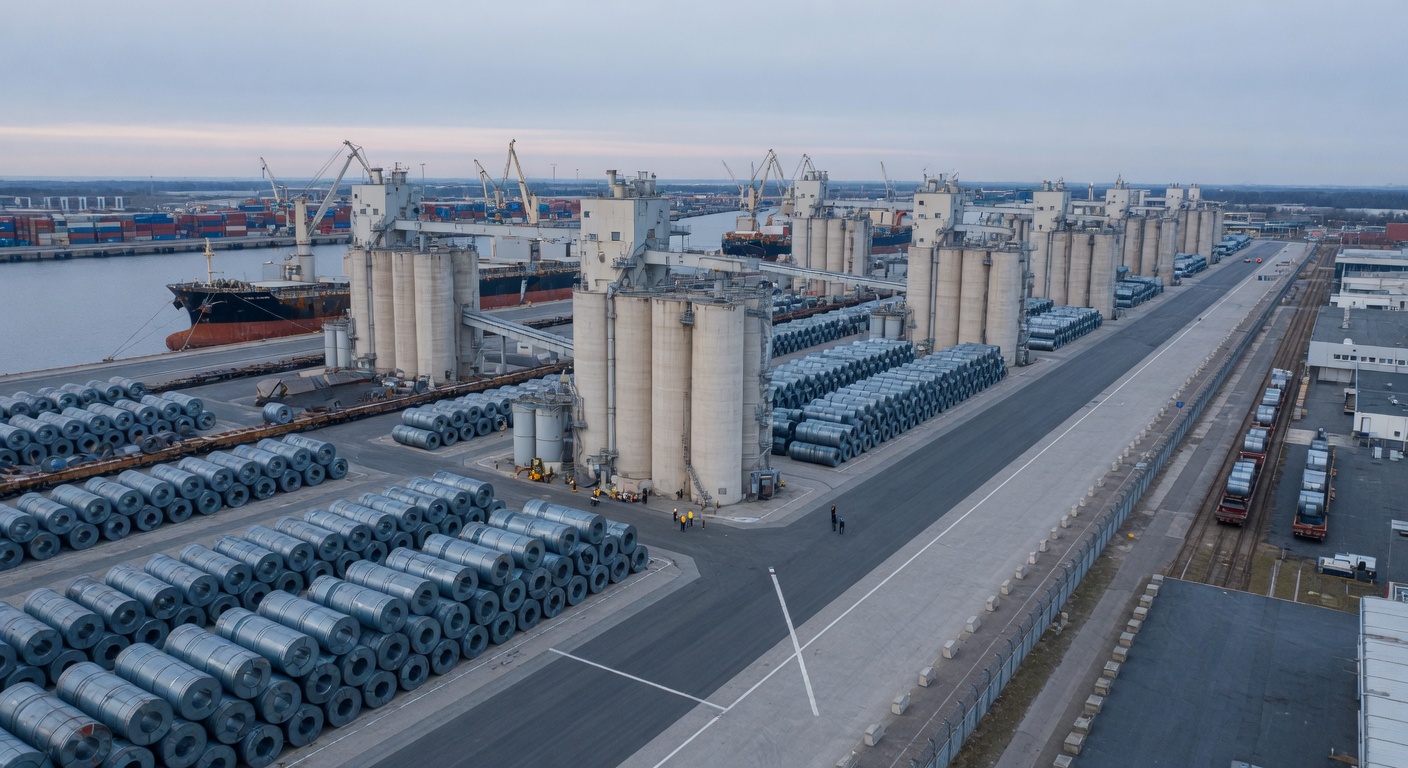
The European Union has priced the planet’s atmosphere at €75.36 per tonne of CO2.
The Border as a Regulatory Instrument
As of May 2026, the Carbon Border Adjustment Mechanism (CBAM) is a concrete financial reality. By pegging the cost of importing carbon-intensive goods—cement, iron, steel, aluminium, fertilisers, electricity, and hydrogen—directly to the EU Emissions Trading System (ETS) auction prices, the Commission is addressing the structural paradox of carbon leakage. The logic is direct: if domestic producers pay for their emissions, importers must do the same. Without this, the EU effectively exports its industrial base to regions with lower environmental standards.
This is not a technical adjustment to trade policy. It is an assertion of regulatory sovereignty. Through the Brussels Effect, the EU forces global producers to internalize European carbon costs to maintain market access. While the European Commission frames this as a climate necessity, the mechanism functions as a strategic tool to align global industrial standards with European legislation.
This projection of power faces internal friction. The resilience of the Green Deal is currently tested by a “simplification” agenda and the geopolitical volatility following the war in Iran. The tension is no longer about whether to decarbonize, but whether the CBAM will serve as a genuine incentive for global greening or a protectionist wall shielding European industry from the competition it claims to encourage.
The Technical Architecture of Carbon Pricing
The CBAM operates as a direct extension of the EU Emissions Trading System (ETS). Rather than imposing a flat tariff, the mechanism pegs the cost of imports to the fluctuating auction prices of ETS allowances. As of May 2026, this has resulted in a certificate price of €75.36 per tonne of CO2, calculated as a quarterly average. Authorized CBAM declarants importing more than 50 tonnes of carbon-intensive goods—specifically cement, iron, steel, aluminium, fertilisers, electricity, and hydrogen—surrender these certificates annually based on embedded emissions.
This architecture eliminates the competitive advantage of producers in regions with lower environmental standards. By ensuring imports face the same carbon costs as domestic EU production, the EU prevents “carbon leakage,” where industry migrates to less regulated jurisdictions. Importers deduct carbon prices already paid in the country of production to avoid double taxation. The legislation is precise. The implementation is complex.
The Tension Between Leadership and Protectionism
The projection of regulatory sovereignty through CBAM has created a structural rift between climate ambition and industrial reality. While the mechanism is framed as a tool for global decarbonization, the risk of “green protectionism” is real. Analysis from Bruegel suggests that empirical evidence for significant carbon leakage is thin, which challenges the fundamental justification for such a disruptive trade instrument. There is a persistent risk of “cascading protectionism,” where industrial lobbying pushes for tariffs to extend further up the value chain. This would shield European firms from the competition that drives innovation.
Internally, this tension manifests as a systematic “simplification” of the Green Deal. The European Commission’s omnibus package is increasingly a rollback of environmental protections to reduce regulatory burdens on industry. The war in Iran has further reframed the Green Deal not as a purely ecological project, but as a security and resilience agenda focused on fossil fuel independence. The goal has shifted from pure sustainability to strategic competitiveness.
Precedents in Regulatory Sovereignty
CBAM is the latest iteration of the “Brussels Effect,” the EU’s capacity to export its internal standards as global norms. By linking its carbon pricing logic to market access, the EU attempts to synchronize global industrial standards. This is evident in current negotiations to link the EU ETS with the UK ETS, particularly as both systems expand to include the maritime sector in 2026. Such synchronization creates a regulatory bloc that stabilizes prices and prevents bilateral trade disputes.
However, this regulatory hegemony is fraught with internal fault lines. A conflict has emerged between the push for industrial-scale green infrastructure and those prioritizing decentralized governance and environmental safeguards, such as those found in the soil law. The pattern suggests a growing gap between legislative ambition and physical reality. The framework for a global carbon price now exists. The political consensus to enforce it does not.
The Sovereignty Choice
The success of CBAM depends on whether the EU can maintain the political will to resist industrial lobbying for “cascading protectionism.” If the mechanism evolves into a shield for inefficient domestic firms, it ceases to be a climate tool and becomes a traditional trade barrier. The structural challenge is that regulatory sovereignty requires a level of internal cohesion that the current “simplification” of the Green Deal undermines. The EU has established the price for carbon. The question is whether it has the courage to let that price actually drive the transition.
Sources
- taxation-customs.ec.europa.eu
- www.homaio.com
- www.bruegel.org
- Analysis of the structural tension between leadership and protectionism.
- Context on the broader resilience of the Green Deal and related laws.
- Context on national interests vs. EU-wide transition goals.
- Financial perspective on the EU ETS and carbon credits.