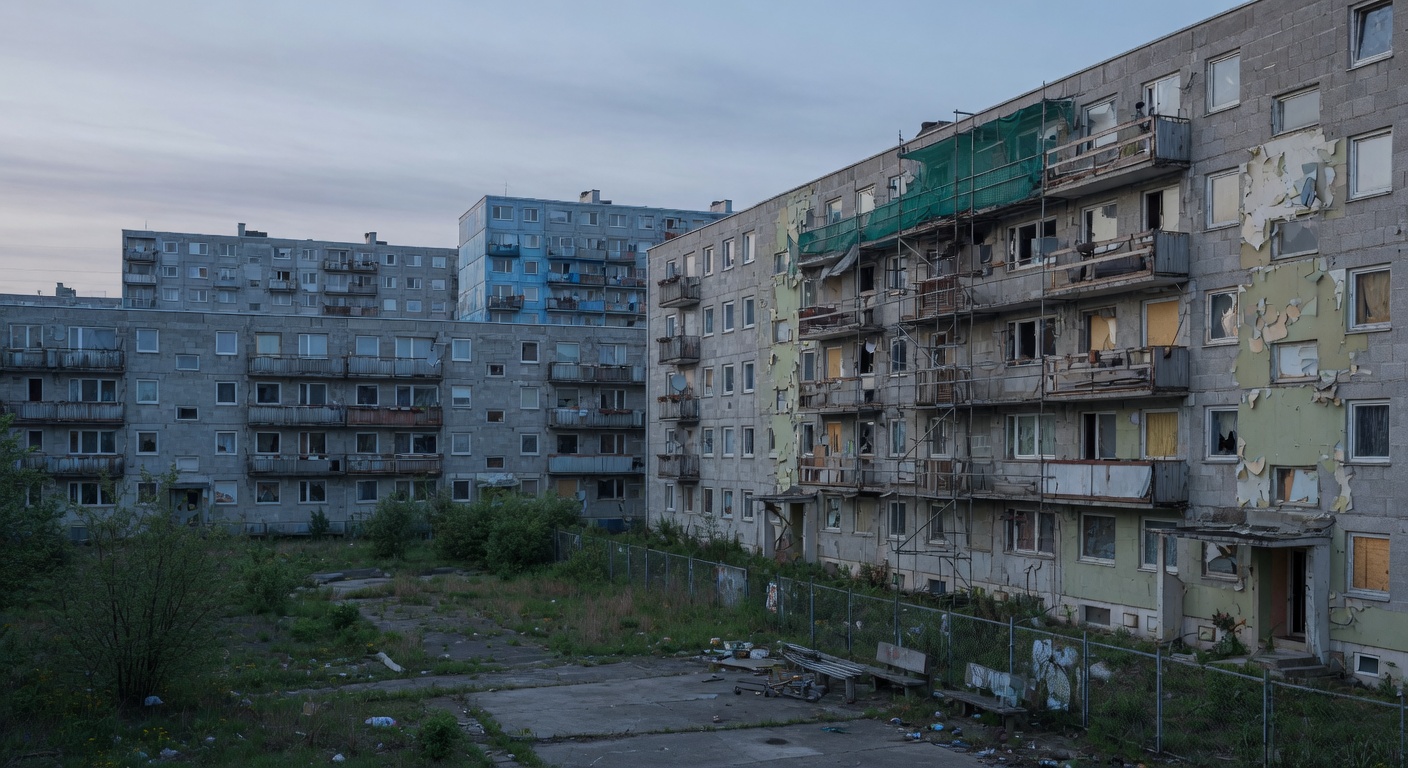
EU citizenship provides the legal right to move across borders, but it offers no portable entitlement to a dignified life. This gap between economic mobility and social security is not a policy oversight; it is a structural feature of a union that coordinates social policy without governing it.
The Failure of Soft Law
In February 2025, the European Parliament and the European Commission recognized a systemic “EU Housing Crisis” European Parliament. This recognition serves as a diagnostic of the failure of the Social Open Method of Coordination (OMC). For decades, the EU has relied on this “soft law” framework—a system of benchmarking and monitoring—to align member state social policies. The OMC lacks enforcement mechanisms to compel states to regulate housing markets or protect citizens from the financialization of residential property.
Housing has transitioned from a fundamental right to a speculative asset. Residential property prices across the EU have increased since 2010, with some markets seeing surges of approximately 50%. This has systematically transferred wealth from the precariat to institutional investors. Commissioner Nicolas Schmit has warned that this division of society is not merely an economic problem, but a risk to the stability of European democracies.
The structural logic is clear: coordination has a ceiling. As national welfare systems undergo retrenchment, the “fourth freedom” of movement is increasingly treated as a form of immigration subject to selectivity and exclusion Barbulescu & Favell. The EU has built a market without a social floor.
The Citizenship Gap
The vulnerability lies in the asymmetry between the “fourth freedom” of movement and the absence of a federal social floor. EU citizenship facilitates economic mobility, yet it lacks a portable entitlement to social security or housing. This creates a structural decoupling where the legal right to move is not matched by a guaranteed right to a dignified life.
Member states have responded to this gap through a “creeping process of retrenchment” Barbulescu & Favell. By treating the movement of EU citizens as a form of “immigration” rather than a fundamental right of citizenship, Germany and the UK have introduced selectivity and exclusion into their welfare systems. The legal framework ensures non-discrimination, but the delivery remains national. The result is a citizenship that is legally robust but socially hollow.
The Assetization of Housing
The housing crisis is not a failure of supply alone. It is a result of the transformation of homes into financial assets. Institutional investors, including private equity and hedge funds, have driven a wealth transfer from the precariat to the wealthy. In several member states, rents spiked—exceeding 100% in certain urban markets between 2010 and late 2023.
This financialization has created a profound generational divide. As of 2022, 9.6 million full-time workers aged 25-34 remained dependent on their parents for housing. This is the structural basis for the resentment currently being leveraged by far-right movements. As Commissioner Nicolas Schmit noted, when housing fails to provide stability, it becomes a risk for the stability of European democracies. The market has succeeded. The society has not.
The Wellbeing Economic Framework
The failure to address these crises is partly a failure of measurement. The EU continues to rely on GDP—a metric that counts “defensive expenditures” like healthcare for pollution-related illness as growth while ignoring the depletion of social cohesion. The “Wellbeing Economy” framework, championed by the Nordic Council of Ministers Nordic Council of Ministers, proposes a shift toward multi-dimensional metrics that prioritize human flourishing and ecological health over raw output.
Alternative models exist within the union, though they remain fragmented. Vienna maintains a consistent stock of social housing for all income levels. The Basque Country’s ‘MAS OPENGELA’ provides hybrid financing for low-income households. In Sweden, ÖrebroBostäder integrates jobless residents into the construction process to ensure social cohesion. These are not anomalies, but proofs of concept. Scaling them requires moving from the coordination of national pilots to the governance of a federal social standard.
The Governance Choice
The transition from a coordination-based social policy to a federal social floor would require treaty revision—a long and politically fraught path. However, the case for this shift is no longer ideological; it is structural. As long as the EU provides the legal right to move without a portable entitlement to a dignified life, the “fourth freedom” will continue to be viewed as a liability by national welfare states and a vulnerability by the citizens who use it.
The choice is between a union of markets and a union of rights. The stability of the project depends on the answer.
Sources
- pub.norden.org
- multimedia.europarl.europa.eu
- eprints.whiterose.ac.uk
- Diagnostic of the failure of the OMC, essential for the “structural” argument.
- Technical reference for wellbeing metrics.
- Narrative link between housing and political instability.
- Examples of cooperative housing solutions.
- Context on demographic transitions and social isolation.