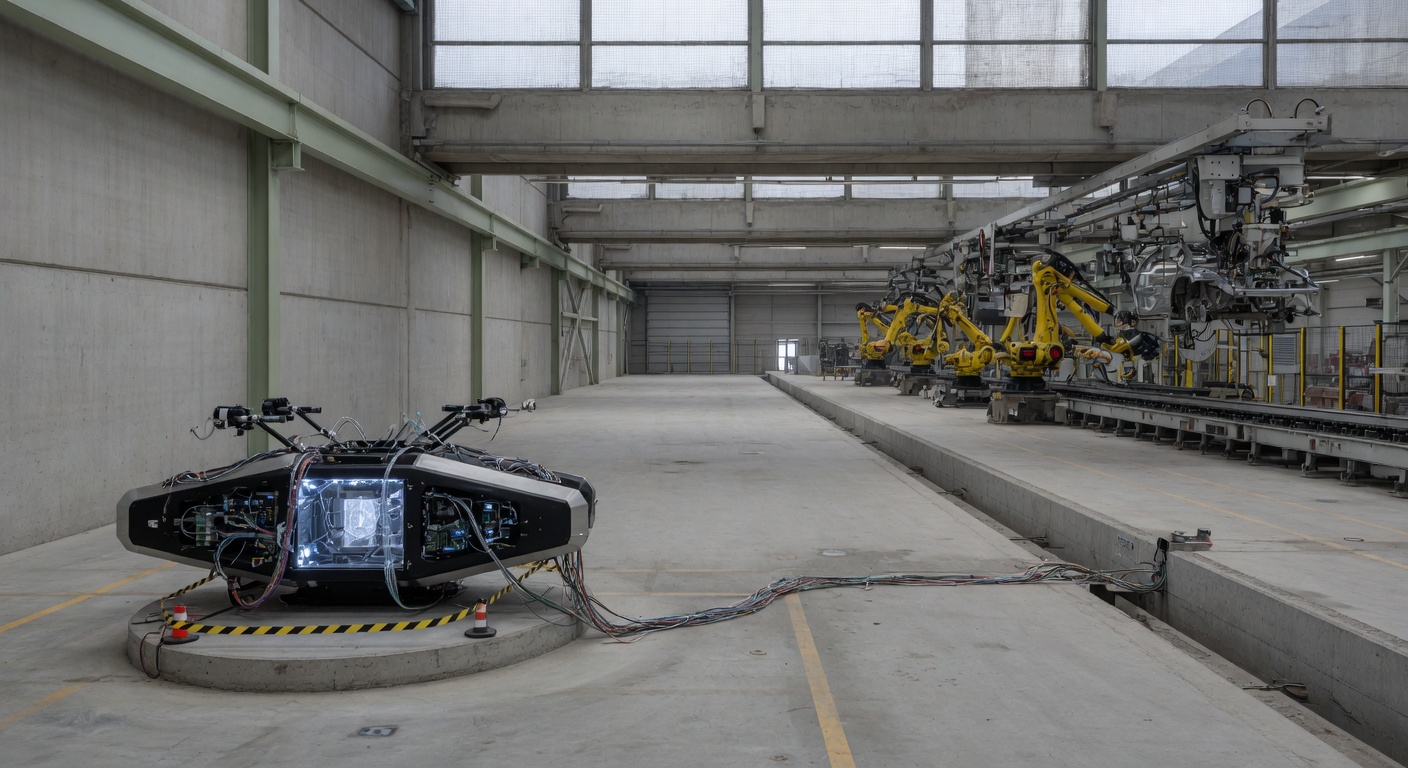
In the United States, high-tech industries—primarily software, computer services, and biotechnology—account for 85% of business R&D expenditure. In the European Union, mid-tech industries, led by the automotive sector, account for roughly 50%.
The Governance Gap between Horizon and ECF
The European Union possesses a world-class capacity for scientific discovery, yet it lacks the structural machinery to deploy that knowledge at scale. This is the “middle-technology trap”: a condition where the EU excels in basic research but remains unable to transition prototypes into dominant industrial standards. This friction is most visible in the disconnect between Horizon Europe, which prioritizes scientific excellence, and the European Competitiveness Fund (ECF), designed for industrial application.
As part of the 2028-2034 Multiannual Financial Framework (MFF), the ECF aims to consolidate 14 fragmented funding streams—totaling €400 billion—to eliminate administrative silos. However, the transition from Technology Readiness Level (TRL) 6 to TRL 8 remains a “valley of death.” Success in a Horizon project does not guarantee a streamlined path to ECF scaling funds; European startups often seek venture capital in the US or succumb to the inertia of member-state-led funding.
The structural logic suggests this fragmentation is not a mere administrative glitch. It is a failure of ambition. By relying on a patchwork of national policies, the EU allows funding to follow political power centers rather than technological promise. In effect, the system subsidizes the maintenance of existing industries rather than the creation of new ones.
The TRL Divergence
The structural tension in European innovation is rooted in the clash between two funding philosophies. Horizon Europe operates on a mandate of scientific excellence and curiosity-driven discovery, while the ECF is designed for industrial scale and market competitiveness. This creates a critical drop-off at TRL 7 and 8—the precise moment when a prototype must transition into a commercial demonstration.
Because success in a Horizon project does not grant a streamlined path to ECF scaling funds, the “valley of death” remains an institutional reality. The shift toward TRL-driven funding, while intended to accelerate deployment, risks marginalizing the foundational research that fuels non-incremental breakthroughs. Organizations like CNRS and Science Europe argue that prioritizing short-term economic goals over scientific autonomy will eventually dry up the innovation pipeline. The funding exists. The synchronization does not.
The Member-State Patchwork
The current innovation landscape is defined by a fragmented, member-state-led approach that lacks the strategic scale of the US or China. Rather than a unified European industrial policy, the EU relies on national funding streams that often follow political power centers rather than technological promise. This creates “innovation deserts” where potential is lost because it lacks the proximity to existing national hubs.
The proposed ECF for the 2028-2034 MFF attempts to rectify this by consolidating 14 fragmented funds—totaling €400 billion—into a single mechanism. As noted in the EPRS briefing, the goal is to eliminate administrative silos and synchronize innovation with deployment. Yet, as long as implementation remains tied to national interests, the EU risks funding the maintenance of legacy industries rather than the creation of new ones. Scale is the requirement. Coordination is the barrier.
The Path Dependency of Mid-Tech
Europe’s inability to escape the “middle-technology trap” is a matter of historical path dependency. For two decades, EU business R&D spending has remained concentrated in mid-tech industries, particularly the automotive sector, while the US shifted its weight toward software, computer services, and biotechnology. In the US, high-tech industries account for 85% of business R&D expenditure; in the EU, mid-tech accounts for roughly 50%.
This stagnation is reinforced by a structural crowding-out effect: public-sector support in the EU may inadvertently subsidize low R&D-intensity industries, cementing a reliance on incremental improvements to existing hardware. As analyzed by CEPR/VoxEU, this creates a cycle where Europe excels at inventing but fails at deploying. The result is a competitive profile that is stable, but static. The trap is not technical. It is structural.
The Cost of Coordination
The consolidation of funding into the European Competitiveness Fund addresses administrative friction, but it does not resolve the underlying political tension. The choice remains between a system that protects existing industrial champions and one that aggressively scales the next generation of high-tech breakthroughs. Transitioning from a patchwork of national interests to a federated industrial strategy would require a level of political integration that currently exceeds the EU’s treaty constraints. Until that gap is closed, Europe will continue to fund the discovery of futures it cannot afford to build. The limitation is political.